Skip to content

News

  • Kingsday Afterparty at Radio Radio Patta

    Kingsday Afterparty at Radio Radio

    After our King’s Day Block Party wraps up, we’re not slowing down! We’re taking things inside. From 20:00, we head into Radio Radio to keep the energy alive all the way through to 06:00. A limited number of tickets are available online, with plenty more held for the door, so come early - first come, first served. Capacity is doubled as Radio Radio is opening up the space at the Krakeling for extra dancing room.  Expect sets from Moxes b2b Emvae, Monty DJ b2b Hannecart, Aldonna b2b Kyra Khaldi, Lil’ Vic b2b Cinnaman, Passion DEEZ, bebe bad, and styn. Find us at radioradio.radio.Doors open at 20:00, 21+ only.
    • Events

  • What went down at Reclaiming Queer Spaces Patta

    What went down at Reclaiming Queer Spaces

    Last week at Patta Amsterdam, we came together to create space beyond nightlife. Centering reflection, dialogue and connection. While the dancefloor remains vital, this gathering was about slowing down and engaging with what it means to build, lose and reclaim queer spaces today.Queer spaces are never fixed. They are shaped through conversation, care, tension and community; constantly evolving alongside the people who inhabit them.With candid conversations between Jinan Viyet, Chloe Heyat, Daniel Smedeman and Sierra Durgaram, the session opened up important reflections on safety, belonging, and navigating creative and public life. Thank you to everyone who showed up and shared. The conversation continues.Photography by Pebbles Bazur
    • What Went Down

  • In The Dance - Manga Saint Hilare, Morenight & Freeza Chin Patta

    In The Dance - Manga Saint Hilare, Morenight & Freeza Chin

    Manga Saint Hilare released his new music video for "In The Dance", a release to heat up spring, preparing us for the festival summer. Check it out now!
    • Music

  • Get Familiar: Finn Askew Patta

    Get Familiar: Finn Askew

    Interview by Passion Dzenga & Liesje Verhave | Photography by Dorian Day With BLUEBOY, Finn Askew sounds like an artist stepping into sharper focus. The Somerset-born songwriter has always known how to bottle emotion, but this latest mixtape feels broader in scope and more deliberate in its storytelling, pulling as much from cinema, made-up worlds and other people’s lives as it does from his own. Still rooted in intimacy, but no longer confined by autobiography, the project marks a clear shift in both confidence and craft.Ahead of his Patta London in-store performance, we caught up with Finn to talk about building BLUEBOY alongside Ezra Skys, learning to trust his own instincts again, finding clarity after a period of self-doubt, and why he’s more interested in telling universal stories than simply retelling his own. From Somerset to Soho, and from bedroom writing sessions to major co-signs and growing international attention, Finn Askew is moving with the kind of quiet certainty that suggests this is only the beginning.What keeps you busy when you’re not making music?Music is basically all I do, even when I’m not trying to. I’m always humming something or thinking about melodies. But outside of that, I’m with my friends a lot, I game a fair bit, and right now cinema is probably my biggest influence. If I’m not in the studio, I’m either in the cinema or in my bedroom making music.So there’s a lot outside of music feeding the music?Definitely. Especially with this mixtape, cinema was probably the biggest influence. I feel really inspired by other people’s stories. A lot of artists talk about writing from the heart, and I get that, but I don’t think that should be the only way to make music. If you only ever write from your own life, you limit yourself. I can’t relate to every single person in the world just through my own stories, and I want the music to reach everyone. So sometimes it’s about making up new stories, or stepping into somebody else’s world.That’s what cinema gives me. You watch a film and suddenly you’re inside a whole different emotional universe. I could write a song about Darth Vader and betrayal if I wanted to. That’s the fun of it.That’s interesting, because in the past your music felt a lot more autobiographical. This tape feels like it opens outwards. Were there any films in particular that fed into BLUEBOY?Yeah, weirdly enough, The Amazing Spider-Man 2. I watched it recently and Peter Parker and Gwen’s relationship, that whole romantic tragedy, really stayed with me. That idea of love and loss definitely influenced some of the songs. There’s a rom-com element to parts of the tape, that sort of dramatic romance.Let’s talk about the mixtape itself. You worked closely with Ezra Skys on this one. How did that relationship come together?I met Ezra about a year ago, and it all happened pretty naturally. We didn’t even release our first track together, which was “Vows”, until maybe six months ago, so in that sense it formed quite quickly. But it just clicked straight away. On our second session together we made “Vows”, and that ended up becoming the first track on the tape.I’d never really made a full project with one person before. That was always something I wanted. I’ve always said I’d love to find one producer I can really build a world with, because coherence and continuity were always things I struggled with in the past. When you’re bouncing between loads of people, it can get messy. But when you’ve got one person you trust, and you’re going back and forth together across every track, it becomes a much more unified thing. That’s what this tape gave me.What does that workflow look like in practice? Are you walking into sessions with finished ideas, or are you building everything from scratch?It changes every time, which is why it stayed fun. Sometimes I come in with an idea already. “Green Light” was something I started at home before bringing it in. Other times Ezra will just build something and I’ll trust it immediately because I know he makes sick beats.That trust is the main thing, really. There’s never any pressure in the room. It’s never like, “We have to finish this today” or “This needs to become a song now.” I can just tell him, “I’m not feeling this anymore, I’m going to take it home and write later.” That happened with “Vows”. We made the beat together, then I took it away and finished it at home because sometimes being on your own lets you try things you wouldn’t do in the studio. Not because you’re uncomfortable, but because the energy is different. You can sit with it more.Most of the melodies are freestyled, though. That’s usually where everything starts. But because the process kept shifting from song to song, it never felt stale.You’ve always sat in an interesting space sonically. There’s singer-songwriter DNA in your music, but you’ve also found a lot of support in more urban spaces, from London to Toronto and beyond. How do you think about your place in music now?I still don’t feel like I’ve fully broken out, to be honest. I feel like I’m breaking into spaces, but I’m not where I want to be yet. Coming from Somerset, there wasn’t really anyone for me to look at and think, “They did it, so I can too.” I didn’t have that local blueprint. A lot of people in bigger cities grow up with examples around them. I didn’t really have that.So for me, it’s been a bit surreal seeing the music travel and connect in different places. That’s always been the dream, though. To make something that goes beyond where I’m from.You’re still based in Somerset now, right?Yeah. I lived in London for about two years, but I moved back around a year ago. London just got a bit lonely for me. Where I’m from, not many people leave, so when I moved there I didn’t really have a built-in crew. Everyone else had their little circles and I was like, where’s mine? Then I realised my people were back home.Until life gets so busy that every day becomes madness, I’m happy being close to my friends and family and just travelling when I need to. London’s only about an hour and a half away anyway, so it’s not some crazy distance.There’s something healthy in knowing where your centre of gravity is. Has the increase in visibility changed your day-to-day much?Not massively, if I’m honest. When I first moved to London, that felt like the biggest lifestyle change. Now, even though the music’s doing really well, my day-to-day still feels pretty grounded. And sometimes that can mess with your head a bit, because you think, “If things are going up, when does life actually feel different?”But I’m also enjoying that not much has changed yet. It makes me stay hungry. I do want the lifestyle to change eventually. I want to tour more, fly more, do bigger shows, live a bigger life through the music. But right now I’m happy where I am in the journey.On “Save My Time”, you talk a lot about slowing down and realigning yourself. What inspired that song?That one came from a very real place. Growing up, and even later on, I spent loads of time in my room writing music, smoking weed, playing games, just kicking back. There was a point a few years ago where I kind of thought I’d already made it. Things were moving, people were paying attention, and I got too comfortable. That was the worst thing I could’ve done.I lost my drive a bit. I was wasting time, really. That’s where “Save My Time” came from. It was me looking at myself and realising nobody else is going to do this for me. I had to snap out of it and fix what wasn’t working. That song really was about seizing time and taking responsibility for my own momentum again.And then you’ve got a song like “London”, which sounds deeply personal, but you’ve said a lot of this project wasn’t necessarily written from your own life. How do you approach that line between personal and universal?That’s what I love about it. “London” sounds personal, and that’s great, but it’s not really my story. It’s more like fiction, or someone else’s perspective. I don’t even know whose story it is exactly, but I know people hear it and think, “That’s me.” That’s what I wanted.I like the idea that something can feel deeply intimate to the listener without literally being my autobiography. That’s the power of storytelling. It doesn’t have to come from me for someone else to feel it in a real way.Which song on the mixtape feels most vulnerable to you, then?Probably “Save My Time”. That’s the one where I really feel the emotion. It’s the one that cuts closest to something I actually had to work through. “Vows” is a real one too, because I wrote that about my girl, so there’s love in that one and that’s definitely personal. But “Save My Time” was me confronting something in myself, and I don’t usually write like that.I’m not really a sad person. I’m pretty upbeat, pretty energetic, so to have one song on the tape where I was like, “Nah, this one is really me,” that felt important.When you look back at the earlier releases, what do you think has changed most in your approach?I think I’ve finally found myself. That’s the biggest thing. For a long time, that was the real issue. I had good people around me, opportunities around me, a lot of things lined up, but I just wasn’t ready. If you haven’t fully figured yourself out, it doesn’t matter how much support you’ve got, people won’t connect with it properly.This tape is the first time I really feel like I know what I want to sound like, what sort of records I want to make, and how I want it to feel. That inner shift is the biggest change. The music changed because I changed.So what have the last few months taught you about yourself as an artist?That I can actually do this. There was a bit of self-doubt before this tape, and I’d never really had that before. I’ve always been confident. Maybe even cocky at times. But there was definitely a period where I questioned things. Then these songs started landing, people started reacting, and I was like, why did I ever doubt myself? I’m good at this. These songs are sick.So yeah, what I’ve learned is: don’t doubt yourself again. There’s no point.And for people going through that same kind of doubt, what would you say?Just trust yourself. If you didn’t doubt yourself before, there’s probably a reason for that. Chase that earlier feeling. That’s usually the real one.We’ve got you in-store this week at Patta London, performing your new EP. What can people expect from seeing you live in that sort of intimate setting?I’m really excited for it. It’s sick to work with a brand I genuinely mess with so heavily. That’s something I’m loving at the moment, being able to work with brands and spaces that actually make sense for me.As for the set, it’s going to be all acoustic. Six songs from the mixtape, stripped back. It’s a small space, very intimate, so I’m just going to let the voice and the guitar do the talking. Good vibes, good energy, proper personal. I’m excited.You mentioned gaming earlier. What are you playing right now?At the moment I’m playing Lord of the Rings: Return to Moria with my brother. It’s kind of like Minecraft, but Lord of the Rings. It’s sick. I also love Cuphead. I need games to challenge me, otherwise I get bored and never finish them, and Cuphead definitely does that. Then there’s Balatro as well, which has had me hooked. Dangerous game, that.You’ve also picked up some major co-signs over the years, from people like SZA, Kehlani and Justin Bieber. What does that kind of validation do for you?It’s mad. Justin Bieber is the big one. That will probably always be the biggest one. He was my idol growing up. There isn’t really anyone else on earth I’d rather have had a co-sign from, so I kind of hit the jackpot there.That sort of thing is crazy because if you told my younger self I’d be speaking to Justin Bieber one day, I wouldn’t have believed you. And yeah, obviously you shouldn’t rely on external validation, but in moments where you are doubting yourself, it helps. It’s nice. It reminds you the music is cutting through.A lot of people know you through different doorways now. Some know the songs, some know the visuals, some know the cosigns, some just know the mood. What keeps you grounded in all of that?Probably home, family, friends and just staying locked into the work. I’m not trying to become some mad version of myself. I’m just trying to get better, make stronger music, do bigger shows and keep evolving. I think if you stay focused on that, everything else becomes a bonus.What can people expect from you over the rest of the year?I already want to start the next tape. I love this mixtape and I’m grateful for what it’s doing, but I’m already onto the next. I miss writing when I’m not writing. So hopefully there’s another project by the end of the year if I can make that happen.We’ve also got a big headline show at coming up, which is at the biggest headline I’ve done so far. That’s going to be crazy. I’m nervous, but excited. Then there are some festivals too, Paris, Copenhagen, stuff like that, and hopefully a few more things land in between. It’s really just about getting busier than I’ve ever been before.So the pace is only picking up from here.That’s the plan. Join us at Patta London on Thursday 23rd April 2026 between 18:00 – 20:00 for a special evening with Finn Askew as he celebrates the release of his new EP.
    • Get Familiar

    • Music

  • Patta x Nike Kingsday Patta

    Patta x Nike Kingsday

     On Monday, April 27th, from 12:00 until 20:00, Patta will be hosting an outdoor Kingsday event at Radio Radio, Amsterdam. This will be open to the public and is free to enter. Due to limited space we suggest arriving early to avoid disappointment.On Saturday, April 25th and Sunday, April 26th the Patta x Nike KNVB Prematch Jersey will be  available for early access exclusively at Patta Amsterdam. Buy your jersey, sign up for customization and secure your slot for Kingday.The customization will take place from 12:00 until 16:00 on Monday, April 27th at Radio Radio. No jersey means no access to the personalisation station and if you miss your slot, there is no second chance to sign up due to limited spaces. 
    • Events

  • Art Bar SEXYLAND with Bonne Reijn Patta

    Art Bar SEXYLAND with Bonne Reijn

    Art Bar SEXYLAND is back! On April 22, we are hosting the 30th edition with Bonne Reijn at Cafe ‘t Mandje. Art Bar SEXYLAND is a café you go to on Wednesdays when you are stuck for ideas, to talk about art or show your work to a renowned artist or curator from the field who acts as your bartender for the evening. It gives emerging or established artists the chance to ask these artists questions in a safe environment without sitting in a Q&A-style setting, because the person is simply standing behind the bar. The motto is bad bartenders, great ideas, so the awkwardness is partly shared by all of us. From Jo-Lene Ong, Rein Wolfs, Rineke Dijkstra, Farida Sedoc, Renzo Martens, Zippora Elders, Wolfgang Tillmans, Kenneth Aidoo, to Iriée Zamblé and Raquel van Haver, every edition features a seasoned artist or curator serving you terribly poorly poured beers but incredibly good ideas.Bonne is a curator, fashion designer, and cultural entrepreneur, as well as the initiator of the Warmoes Biennial. His practice does not originate from the studio, but from the street, specifically the Warmoesstraat and its immediate surroundings, where he grew up and works. Rein’s work is closely connected to the question of how a neighborhood can redefine itself. Driven by a strong commitment to the Warmoesstraat, an area often reduced to tourism and clichés, he uses art as a means to present a multi-voiced and layered image.In this context, the Warmoes Biennial functions as a collective attempt to shift the dominant narrative and activate new forms of community. Through art, the biennale infiltrates the neighborhood; shops, snack bars, churches, and nightlife spots are temporarily transformed into exhibition spaces. Here, art does not appear as a destination, but as an intervention in everyday life.His role moves between curator, designer, and initiator: he creates not objects, but circumstances. In this context, art becomes a social process, a temporary infrastructure in which encounter, friction, and imagination converge.
    • Events

  • Finn Askew at Patta London Patta

    Finn Askew at Patta London

    Join us at Patta London on Thursday 23rd April 2026 between 18:00 – 20:00 for a special evening with Finn Askew as he celebrates the release of his new EP.We’re hosting an intimate in-store listening event where Finn will perform an exclusive acoustic set, giving you a closer, stripped-back experience of his latest project. If you’ve been following his sound, this is the kind of setting where it really lands: raw, direct, and personal. Entry is first-come, first-served, and everyone’s welcome, so pull up early to secure your spot. To keep things moving, we’ll have food provided by Wingstop, along with drinks courtesy of Mirchi and Peak. Come through, tap in with the music, and spend the evening with us.
    • Events

  • Get Familiar: Conrad Soundsystem Patta

    Get Familiar: Conrad Soundsystem

    Interview by Passion Dzenga | Photography by Charlotte van der GaagSpread across cities, schedules, and parallel lives, the Conrad Soundsystem only occasionally occupy the same room, but when they do, something immediate and unfiltered happens. Their music isn’t the result of endless iteration or remote file-sharing, but of short, concentrated bursts: weekends carved out of busy lives, where ideas collide and instinct leads.Formed during the stillness of lockdown in The Hague, the project grew out of living room sessions on Conradkade, a literal sound system between friends that quickly evolved into something more defined. Alongside their label and event series Fish Tapes, and a deep connection to the coastal energy of The Shore, they have built a world that feels both personal and communal, rooted in friendship, but outward-facing in its intent.That same tension runs through their music. There’s a push and pull between raw intuition and careful refinement, between high-pressure rhythmic tracks and more expansive, emotional compositions. Their latest release on United Identities, West End, captures that balance perfectly: a record built as much on restraint and tension as it is on release.At a time when electronic music can feel increasingly polished and predictable, Conrad Soundsystem lean into something more human — embracing imperfection, trusting the moment, and treating each track as a document of time spent together.You’re a three-man collective with a close personal connection. Can you talk a little bit about those relationships and how they play out when you’re in the studio?We’re very close, but in practice, it actually takes effort to come together. We don’t naturally bump into each other all the time anymore. Some of us are in different cities, some of us are working on projects abroad, and everyone has their own schedule, so being in the same room has to be planned very intentionally.That definitely shapes the music. When we do get together, there’s a certain pressure, but it’s a good pressure. We know the time is limited, so there’s a lot of energy in the room. We’re never short on ideas. It’s never like, “What should we make?” It’s more about how to use the time wisely and pour all the ideas we’ve been carrying individually into one session. Because we don’t see each other constantly, everyone comes in with fresh thoughts, and that creates this explosion when we finally link up.So it’s less about struggling for inspiration and more about maximizing the window you have together?Exactly. It’s always about time, never ideas. That’s why the sessions tend to be so intense and so focused. We just try to get as much as possible out of the time we have.From my understanding, the mixing and mastering also stays in-house. How does that help define the Conrad Soundsystem identity?The three of us are together for the core creative part, and then the final shaping also stays very close to home. What matters most to us is keeping the first impulse intact. We don’t want to overproduce the music or polish out the parts that made it exciting in the first place.There’s a nice tension in that process because technically, we all come from different places. Some of us are much more instinctive and rough with how we build things, and some of us are more trained and detail-oriented. So there’s always this back-and-forth between wanting to clean something up and wanting to leave it alone because it just feels right. Sometimes a snare is too hard or something isn’t technically perfect, but if it sounded sick in the room and all three of us felt it, then that becomes part of the character.That’s also why the music can sound a bit as if it exists in its own vacuum. Sometimes we wonder if we should sound more like one scene or another, but because of the way we work, it always ends up sounding like us. That can make things harder at first, because people don’t know where to place you, but it also becomes your strength over time.Speaking of interpersonal dynamics, there’s also family involved here. Did that make things smoother or more complicated?It honestly helps. Music is the basis of the connection anyway. Even outside the studio, that’s what pulls everything together. At family gatherings, we’ll end up in the corner talking about tracks while everyone else is having normal conversations. It probably looks a bit ridiculous, but that’s genuinely how we stay connected.That’s also the nice thing about having relationships outside of music — you understand each other beyond just the work. You don’t have to explain everything from scratch every time. There’s already a shared language there.One thing I really like about the project is that you move like a trio. Do you always build in the same room, or do you ever send ideas back and forth?We used to send projects around a lot more, especially during COVID. One person would start something, then another would work on it, and by the time we got together there was already quite a developed sketch. But that’s changed.Now we prefer going into the studio almost blank. We keep ideas in our heads and save them for when we’re together. Then everything happens in the room. That feels much better for us now because it keeps the process intuitive and immediate. Instead of continuing separate demos, we’re smashing all our ideas together in real time.It also makes the tracks feel tied to very specific moments. Some of the songs really hold the memory of the session inside them. That’s something we love. If you build a track over weeks by sending it back and forth, it can become more universal, but if you make it in one intense session, it captures a very particular feeling. For us, that makes it more fun and more real.It also feels like a way of documenting friendship. Like these records become time capsules.Yeah, definitely. As you get older, life gets busier and more fragmented, so being able to make music with people you actually love becomes more valuable. These tracks really do feel like little time capsules of where we were, what was happening, and how we were feeling when we made them.I was first exposed to your music through the United Identities compilation around the end of COVID. Was that when Conrad Soundsystem really started?Yeah, pretty much. The real kickoff was during COVID. One of us had just come back from Berlin and got re-energized musically. There had already been a shared love of music, shared listening, sending each other radio shows, jazz, strange club tracks, all of that. Then lockdown hit, and suddenly there was time and space to do something with it.We started playing records together at home, throwing little living room parties with our turntables, speakers, and record bags. The street we were on was Conradkade, and that’s basically where the name came from. It started as a very literal sound system in a house.At the same time, there was already someone in the orbit who understood music in a slightly different way — not just emotionally, but technically too. We’d play tunes and talk about why they hit, and he’d immediately hear how they were made, what was going on structurally. That made it feel natural to move into making our own music together.Around that same time, Fish Tapes also starts to take shape. What was the impetus there?Fish Tapes came out of necessity at first. We had made a lot of music early on and built up an EP, and we were sending it around to labels because we really believed in it. That didn’t lead anywhere that felt right, so we thought: let’s just do it ourselves.At the same time, we got access to a studio space and there was an opportunity through friends to start doing parties at The Shore. So suddenly the music, the events, the studio, the friendships — it all landed at once. Fish Tapes became the umbrella for that world.It’s basically our little playground. We release our own music there, release music by friends, do compilations, and use it as a platform to build events around the artists we love.And The Shore became a real key part of that world.For sure. The Shore gave us a space to build something without overthinking it. The early parties were free, really open, really mixed. We didn’t want them to feel too serious. It was just about good music, good people, and creating a vibe.Over time it grew way beyond that. Suddenly there were huge crowds, bigger stages, serious sound systems, and proper lineups. But the spirit stayed the same. It still feels like a place where we can book our favorite artists and try things out. That’s where we’ve brought people like Carista, Tash LC, T.No and a lot of others. It’s become a seasonal ritual for us, and also a place where we can test our own music on a real system.There really is a special energy to partying by the water in Scheveningen. It gives The Hague its own identity outside of the PIP ecosystem.Definitely. It’s a different energy. The Shore has its own character, and that’s part of what made it such a special place for Fish Tapes to grow.Let’s talk about the new release on United Identities, West End. It sounds built for big sound systems. What was the starting point for that record?We’d had United Identities in mind for quite a while. After the Modern Intimacy compilation, there was already a connection there, and Carista had basically told us: send over whatever you’ve got. So when we started making the EP, that label was very much in the back of our minds.There were definitely a few key reference points. Tracks like Rhyw’s Honey Badger and Joy Orbison’s Flight FM were in the air for us — those records that create this huge sense of momentum and tension without necessarily relying on the obvious drop. We love tracks that feel hectic, restless, a little bit unstable.A lot of West End came together in a weird studio space near an indoor beach volleyball place, which already had its own strange energy. We’d go outside to take a break and see people playing volleyball in the middle of winter, then go back in and make this tense, wired music. So the surroundings were bizarre, but that kind of fed into the record.The title also came from where it was made — part of our naming logic is very literal like that. But there’s also another layer to it, with one of us having moved west, so it held that too.One thing that really stands out on West End is that it never fully releases. It keeps stretching the tension.That was very conscious. We’re really drawn to that feeling — making something uneasy, but in a good way. We love tracks that don’t just build, drop, resolve, repeat. Sometimes, the most exciting thing is when a track keeps you on edge.One of the records that really shaped our thinking was III’s Front by Overmono. It doesn’t really “go” anywhere in the traditional sense, but it keeps shifting and pulling at you. That’s much more interesting to us than just hearing another familiar drop.On West End, a big part of that came from using one main lead sound and constantly evolving the rhythm. The sound itself stays similar, but the phrasing keeps changing, so you’re always being pulled slightly off balance. That was a really fun way of building tension without needing to throw in a huge, obvious payoff.And then the B-side, Lindo, opens up a much darker, more inward space. How did you balance those two records?That’s really the two sides of us. On one side, there’s rhythm, pressure, drums, tension. On the other hand, there’s harmony, big chords, emotional weight, and cinematic feeling. Lindo came out of us, leaning into that second side. It started with these huge synth chords that suddenly made the track feel almost like a score. That was exciting because it gave us a chance to break open the dancefloor a bit instead of constantly pushing it harder. We didn’t want it to be drenched in harmony the whole time though — it’s more about teasing that emotional side, letting those sounds appear and disappear so you really feel the space in between. That’s why the two tracks make sense together. They’re very different, but they need each other. One pushes outward, the other pulls inward.Funny enough, you’re getting almost a 50/50 split on the favorite track from the promo reactions.Yeah, which surprised us a bit, but it’s nice. It means both sides are landing.Before you were musicians, were you DJs first?In a way, yeah. DJing came very naturally out of obsession. Once you start collecting records, once you get deep enough into music, you’re going to want to play it somehow. That’s just what happens. There were different paths into that. Some of us were DJing around PIP very young, buying turntables, building collections, playing with friends. Some of us came from bands first, and then electronic music took over. Some of us have been producing for a long time already. But all of it comes back to the same thing: a deep obsession with music and the urge to share it.Vinyl was especially important in the beginning. It still is, really. There’s something about records that keeps you physically connected to the music. It slows you down in the right way. It makes digging feel meaningful.That’s also what makes electronic music such a self-sustaining culture. It’s its own ecosystem.Exactly. One of the beautiful things about electronic music is that the music itself matters more than the persona around it. Half the records we love, we barely know anything about the person who made them. Sometimes that’s the point. There’s this endless stream of anonymous or semi-anonymous music, and it becomes less about ego and more about contribution.That’s something we really love about the scene. It feels like a long, ongoing conversation where everyone adds something to the pile.Let’s close on what’s next. You have the West End release party coming up. What can people expect?The release party is really about bringing all the threads together. It’s happening in collaboration with Dooorp, who are doing some of the most exciting things in The Hague right now. They’ve got that same mentality we believe in — just doing what feels right, taking risks, making things happen for the love of it.So the party is going to be a full-circle moment: friends doing visuals, close collaborators on the lineup, another stage hosted by people we love, and a proper sound system. It’s not just a release party, it’s a celebration of the wider scene around us. It’s on Friday, April 17th at LAAK in The Hague, and yeah, it’s going to be special.And if someone is just discovering Conrad Soundsystem, where should they start?Anywhere, honestly. The catalog is still small enough that you can really dig through it properly. There are the early Fish Tapes releases, the compilation tracks like 38A and Saturn, and now the new EP. Every track holds a different part of the project. That said, West End probably feels like the clearest statement of where we are right now.West End lands as Conrad Soundsystem’s most defined statement to date: a tense, soundsystem-centric record designed to be felt as much as heard. Out now via United Identities, the release captures the trio at their most focused, balancing pressure, rhythm, and emotion across both sides of the EP. To mark the release, Conrad Soundsystem bring their world to life on Friday, April 17th at LAAK in The Hague, joining forces with Dooorp, Pip Radio and United Identities for a night that reflects the community around them. Expect a full-spectrum experience: heavyweight sound, close collaborators on the lineup, and a raw, unfiltered energy that mirrors the way their music is made. West End by Conrad Soundsystem 
    • Get Familiar

    • Music

  • Reclaiming Queer Space Through Conversation Patta

    Reclaiming Queer Space Through Conversation

    Join us for a community-centered panel talk at the Patta Amsterdam, this Friday from 17.30 onwards.While nightlife is essential for bringing people together, there is a growing need for environments that allow for deeper reflection and connection. After the Dancefloor is a response to this shift, prioritizing exchange over spectacle and presence over performance.The session brings together voices from across creative communities and beyond to reflect on what it means to build, lose, and reclaim queer spaces today.Queer spaces are never static; they are shaped through dialogue, visibility, tension, care, and community. In a time where questions of safety, belonging, and representation continue to evolve, conversations like these feel increasingly necessary. The talk opens up space to reflect on how queer people navigate creative industries and public life, and how inclusivity is not a fixed state but an ongoing practice.An invitation to slow down, listen, and engage.Limited spots are available, be early as full=full.RVSP here. 
    • Events

  • Skate for Suriname at Skatecafé Patta

    Skate for Suriname at Skatecafé

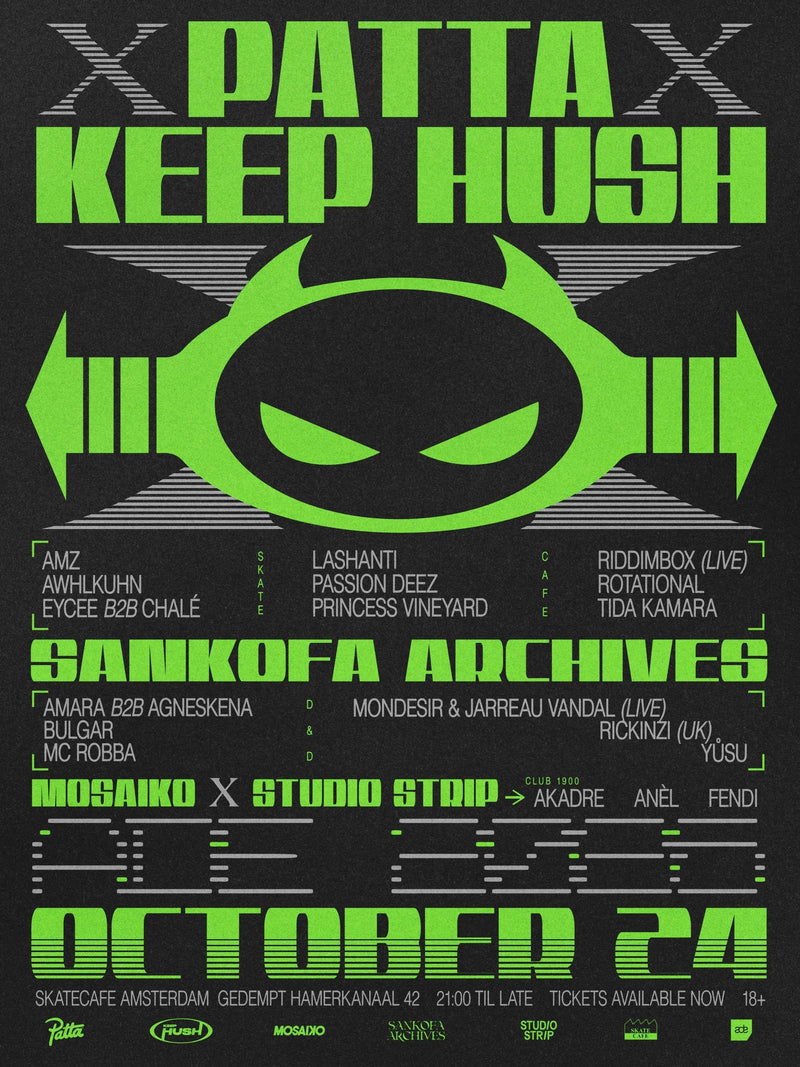
    On April 18th at Skatecafé, Amsterdam, we’re bringing the community together for a fundraiser to build a skatepark in Suriname.14:00 till 19:00Expect a full day of skating, music, food and energy, all for a bigger purpose.CASH FOR TRICKS16:00 / 17:00 / 18:00€2000 prize purseBBQ + drinks (donation-based). Auction with exclusive items hosted by Akadre.Music by AMARA, Bxxmbastic and Passion DEEZ. Come through, skate & support!
    • Events

    • Foundation

  • namesbliss - Daily Duppy | GRM Daily Patta

    namesbliss - Daily Duppy | GRM Daily

    namesbliss is carving out his own lane in the U.K. rap scene. The artist showcases his grime, jazz and real storytelling on the latest edition of GRM Daily's "Daily Duppy" series. 
    • Music

  • Virgil van Dijk for Fantastic Man

    Virgil van Dijk for Fantastic Man

    Captured by David Sims for Fantastic Man 42. Now on stands, including at Patta Chapters in Amsterdam and London.Dive into the cover story here.
    • Magazine

  • What went down at Mouth Full of Golds Book Signing Patta

    What went down at Mouth Full of Golds Book Signing

    Photography by Sam Davies and Dennis EluyefaTo kick off the week, Patta London linked up with Eddie Gold to celebrate the release of Mouth Full of Gold. We hosted a book signing at our London chapter, bringing together an international community to welcome Eddie back the right way. Shoutout Mirchi for keeping the drinks flowing. Watch this space London, we will be back with more events soon. 
    • What Went Down

  • Mouth Full of Gold at Patta London Patta

    Mouth Full of Golds at Patta London

    Big moment this Tuesday. For those who know, you know. Eddie Plein is a Surinamese-born pioneer who helped shape grillz culture in hip-hop long before it hit the mainstream. A real originator — not a follower.He’s blessed some of the greats, including LL Cool J and Eric B. & Rakim — laying down influence that still echoes today. Now he’s pulling up to Patta London for the official launch of his book, bringing his story and legacy with him.He’ll be in-store, meeting everyone and signing copies — so this is more than just a launch, it’s a rare chance to connect with someone who really built from the ground up.
    • Events

  • Get Familiar: Charity Charly Patta

    Get Familiar: Charity Charly

    Interview by Liesje Verhave | Photography by Brunei DeneumostierIn her directorial debut, Tra Fasi (2026), filmmaker Charity Charly steps into Suriname’s underground punk scene through the story of Shavero Ferrier. Shavero, a young cultural organiser, creates space for punk parties and self-expression in a society that often leans toward conformity. Charly, with a multidisciplinary background in film from camerawork and styling to set design, brings a personal and multifocal lens to her work.  Driven by a desire to reveal overlooked experiences and challenge dominant narratives. We spoke with her about her first steps into filmmaking, the making of Tra Fasi, and her vision for the visual stories still to be told. You’re quite a multidisciplinary creative. How did your journey from camerawoman to director, and this “jack-of-all-trades” path, begin?My journey started as a videographer. I worked at BNNVARA, where I was directing, editing, and doing camera work all at once for their YouTube platform. I always felt that I was good at what I was doing, but something felt a bit off. I just wanted to direct. I had so many stories in my head, and I just wanted to focus on directing only. So that is where my dream of becoming a director started. To make a film, I knew I needed experience on set, so I started as a production coordinator. Then I moved into costume styling, and after that into set dressing. After doing all of that, I finally had the courage to direct my own film. Tra Fasi is really the start of my directing journey, although I’ve been working in film for about four years now.So you tried out every possible role in the film industry first before directing?Exactly. But I always felt the urge to direct. Even when I was on set watching directors, I would think, “I would do this differently, or I would do that.” That feeling was always there.Do you think working in all those roles informs how you direct now?Yeah, definitely. All the departments I’ve worked in have helped me develop a clearer vision of what I want to see on screen.What first drew you to visual storytelling like film and visual art?I was always obsessed with films. I could watch the same movie eight times in a row and memorize the whole script. I would perform it and make my brother play the other roles with me.I also used to ask my mom to sign me up as an extra in films. But when I was on set, I wasn’t focused on being an extra; I was watching the crew. I was always distracted by how everything worked behind the scenes. Somehow, I always knew I wanted to make films. Even as a kid, I used to say my name would be in the credits one day.Are there any films you remember from that time?Yeah, Like Mike with Lil’ Bow Wow. That was one of my favorites. I knew it by heart and used to act it out with my brother while playing basketball.You’re largely self-taught. What challenges came with that?I used to study media studies, but didn’t finish. I ended up going to university for media and culture, but left after seven months. I was bored. I thought, “Do I really need to know this to work on sets?” So I was like, let me find out how I can do this on my own. The biggest challenge was insecurity. You hear a lot about people who went to film school and, after that, their careers just get a major boost. I struggled with representation. Not seeing people who look like me doing this work, there were times I felt like I didn’t belong.I remember wanting to become an actress and getting through the first round of auditions, but I got so insecure that I didn’t go to the second round. I started doubting whether there would even be roles for someone like me.But once I knew I wanted to direct, things started falling into place. I was very open about what I wanted to do, wrote scripts, and connected with people. I was really curious, and at some point, I just stopped letting rejection discourage me. Even though I heard a lot of no, I kept going. For me, this was a big milestone because this is what I wanted to do. Are there other art forms you still want to explore?Definitely, it’s actually funny because I never thought I’d make a documentary; it just happened. I’m still very obsessed with fictional stories and the way you can portray them. I would love to explore that more.I also acted on screen for the first time last year and really liked it, so I want to develop that further. And I make resin art, I love working with my hands. That’s something I’ll keep developing as well.Is the resin work more of a hobby or something you want to build professionally?It started as a hobby. Also, funny story, I made ashtrays and posted them on Instagram, and people wanted to buy them even though I wasn’t selling them yet. That made me realize I could turn it into something more. Now I make custom pieces for customers.How did the story of Tra Fasi come together? How did you meet Shavero?It started with the idea of making a documentary about Black punkers in the Netherlands. But I found that there were already projects about that.Then I realized I was going to Suriname soon and got curious about punk there. I started researching and discovered it actually existed. I found an article about Shavero and his band Mutha Flac, and something about him really stood out to me.I started following him on Instagram and noticed this whole alternative scene. I was like, “How did I not know this existed? I go to Suriname every year and never see this.”I messaged him, and he responded quickly. We had a call, and at first I planned to make a documentary about multiple bands, but none of them interested me as much as Shavero. So I told him I wanted to focus on him, and he said, “That’s dope, I’ll organize an event when you’re here.” So I was like, “Okay, let’s go. I’ll capture that.”That’s how it started. Once I got to Suriname, everything shifted. I had a plan, but after the first day, I realized I had to let go of it. The environment, the heat, not being able to film before 3 or 4 - it all required a different approach. I just went with the flow.What stood out to you about that scene?The energy. Because events aren’t as frequent there, people really go all out. The love and intensity are on another level. It’s a completely different energy.You also brought Shavero to the Netherlands. How was that experience?It wasn’t even the plan at first to do a tour here. My DOP Nadine Haselier and I just wanted to bring him here so he could connect with people. He does so much for the community, so we just wanted to do something for him. We started crowdfunding, and it gained so much attention that venues wanted him to perform.Seeing him perform here was emotional. The Garage Noord concert was crazy. I crowd surfed for the first time in my life. Watching his dream come true and seeing how people responded to him and his sound, it was special. It felt like two worlds colliding. The film centers on self-expression in a conformist society. How did you approach that visually?I didn’t overthink it. I used strong visuals of Suriname and contrasted that with Shavero’s self-expression. The editing style is very DIY. The whole film just screams self-expression.Did anything about the experience in Suriname change you?Completely. It changed how I see Suriname. I didn’t expect that scene to be there, and I felt both surprised and a bit guilty for thinking it didn’t exist there.Seeing people who look like me and share the same mindset, the same attitude in life, was such a beautiful enlightenment. But at the same time, I realized how much harder it is to express yourself there compared to here. I will still get that job even though I dye my eyebrows blonde; there, you have to be ten times bolder to be yourself.That experience really shifted my perspective and deepened my connection to my motherland.You’re working on a new project now. How are you approaching it differently?With every project, you learn and want to do things differently. I always try to give something nostalgic and to surprise people, to make people think differently about stereotypes and question themselves.  I’m currently working on a new film about the gabber/hardcore scene in the Netherlands, focusing on black youth within that scene.It’s a similar niche approach, highlighting something we haven’t really seen.What drew you to that scene?I don’t even listen to hardcore, and that’s what makes it interesting to me. I’m curious about what draws people to that scene. Hardcore never dies!I started researching and found a whole bunch of young black kids going hard to this music. Even though I don’t like the music, seeing them loving it so much fascinates me. I’m going to a hardcore party soon to experience it firsthand.What perspective do you want to bring to that story?I want to show it from the perspective of people of color, especially women. Most of what we’ve seen before is from a very white, male perspective. I want to do the complete opposite.For me, the reason to make something is simple: if we haven’t seen it yet, that’s exactly why it needs to be made.What can people expect from the upcoming Tra Fasi screenings?A good film and a new, refreshing perspective on Suriname! At the Melkweg, I’ll also be doing a Q&A, chit-chat about the movie and the process. I’m really excited to talk to people also afterwards. Upcoming Screenings: 4/04 Melkweg24/04 Paard Den Haag10/05 Humans of Film Festival22/05 Plantage Dok Amsterdam5/07 Down The Rabbit Hole
    • Film & Documentaries

    • Get Familiar

  • Get Familiar: TYSON Patta

    Get Familiar: TYSON

    Interview by Liesje Verhave | Photography by nothing_._yetTYSON has always existed in a musical space of her own, one where alternative textures meet an R&B sensibility, and where collaboration feels as instinctive as solitude. We connect with her to discuss her featuring on Sam Akpro’s new single “Wayside”, The release follows a steady run of celebrated work, from her 2024 CHOAS EP to collaborations with artists such as Leon Vynehall, Dean Blunt and Coby Sey, as well as her recent appearance on Yazmin Lacey’s “Water.” Alongside her music, TYSON continues to build community through Ladies Music Pub, the London-based collective she co-founded to support women and gender-nonconforming people in the industry.In this conversation, TYSON reflects on the making of “Wayside”, the evolving nature of collaboration, and how her creative process is shifting, shaped by new environments, new experiences, and the realities of motherhood.We wanted to connect with you because of the release of the new single by Sam Akpro “Wayside” that you featured on. How was it working on that tune, and what was the process like when he first shared it with you?For me, it wasn’t an unusual process, but it was a different one. He had already started the song, not in its finished form, but enough to have an early version - and then he thought of me to feature on it. A lot of the features I’ve done have either been someone featuring on my work or us starting something from scratch together. So it was really nice that he had already begun something and thought I could add to it.I came down to the studio, heard the early version, and we just started trying things out. It ended up being quite an eventful day. I had sketched out some ideas and was about to record when the fire alarm went off. At first, there were sirens and lots of people everywhere, but both Sam and I were very chill and didn’t think it was serious. Then his friend, who was helping produce, was like, “No guys, I think something’s actually happening.” It turned out the building next door was really on fire. Everyone was okay, but we had to run down the stairs. I even had my coffee with me because I really thought it wasn’t a big deal. Then I looked over and saw flames coming out of the side of the building. So for quite a calm song, it was definitely a dramatic afternoon.Did the eventful afternoon influence how the song ended up? Definitely, it added to the energy, and it’s a good story. It’s funny because the song itself is so calm, but the day we made it was the complete opposite.You mentioned that Sam picked you for the tune and that this collaborative process was a bit different from how you usually work. Can you talk about how your collaborations usually come about, and what made this one unique?A lot of the people I’ve collaborated with are friends. I didn’t know Sam Akpro before we met to do this. Someone like Coby Sey is a long-term, consistent collaborator, and because we’re friends, the process usually starts there and then we make something from scratch. Working with Leon Vynehall was similar, we knew each other, but became closer while working together, and we made something from scratch for his project.Most of the people I’ve worked with, especially in London, I’ve met through music scenes, partying, and mutual friends. I like that process, because you get to feel someone’s vibe first. Usually, by the time we make something, there’s a sense of how it’s going to go because you’ve met each other beforehand.Since having my daughter in 2024, though, I’ve done more sessions that have been set up through my publisher and management. That means I’m often meeting people for the first time in the studio, which is very different. This song is part of that era, but it felt aligned with the way I’ve worked before because Sam and I come from a similar world, and our music fits well together. If we hadn’t met through the song, I think we would have met very soon anyway.How has meeting people for the first time in the studio and immediately working on a song influenced you as an artist?I’ve learned a lot from those sessions. I really wanted to write more for other artists, and it lets me use my creativity in a different way. I love lots of different styles of music, but I don’t necessarily want to perform all of them myself, so it’s a nice way to experiment with different genres and writing styles.I haven’t done many writing camps, but I did one in Sweden for women and non-binary artists, producers, and writers. I was there as a writer, and I think those spaces are a good exercise in just going into a room and making things. It’s less about ego and more about being open. Quite a lot of what we made had a bunch of people on it, and only later did you start thinking about who it was for.I think those sessions are a bit like blind dates. It’s always good to start by talking for a bit and listening to some music together if you’ve never met. Sometimes it’s nice to just see what happens, but sometimes it also helps if there’s some intention from the start — whether that’s for someone’s album, or for your own project — so you don’t get to the end and think, “I’m not actually sure I’d put this out.”How was your experience participating in the writing camp in Sweden, especially since you grew up there for part of your life? Do these different cultural experiences inform your work?Definitely. It was actually really interesting to go back there in that context. I lived in Sweden from age 15 to 20, and also spent quite a lot of time there in my early 20s. The last time I properly lived there, I was around 26, and I remember thinking, “That’s it — I know I don’t want to live here again.” I knew I wanted to spend time there, but I also knew my soul didn’t really belong there.So I stopped going as much, and a lot of my experiences there are rooted in youth. But in recent years, I’ve gone back more for work, and that’s been really interesting. There are so many amazing and inspiring artists there. I met people at the camp and then returned for more writing trips. I think the alternative music scenes in Stockholm and in Sweden generally are really exciting.It feels a bit like going home, but in a strange way. People often assume I’m just fully from London, but culturally a lot of my references are also Swedish, even if they’re not very current because I haven’t lived there since I was a teenager. So it still feels like home. I really admire the way writers and producers in Sweden approach music.What do you love about Sweden?I actually had an amazing time in Stockholm, and it was really important for me. I moved there when I was 15, which is kind of the worst age to move from London to a much smaller, colder, less diverse city, especially right when all your friends back home are discovering raves and nightlife. At the time, it felt terrible, but in many ways, it was the best thing my parents could have done for me.I made amazing friends there who became like family. But it’s not an easy place to live if you’re not white and Swedish. When you’re a teenager, I think you mould yourself in order to fit in and survive, and that’s what I did. I found ways to kind of “Swedify” myself to make it work. Now that I’m older, when I go back, I feel more friction because there are parts of me that aren’t really accepted there, and I’m less willing to adapt those parts of myself now.At the same time, I am also Swedish, so it’s not as simple as being a foreigner there. That’s why it’s complicated. But having a child has made me want to reconnect with that part of myself and share it with her, because she’s also Swedish. That’s made me find a new love for being there again. Going back there with purpose - going there to work, to connect with people, to make new memories — has been really helpful. And beyond that, I love the countryside. I could stay forever in our family house in the south of Sweden. The house my grandparents built feels like its own universe. So I think it’s really Stockholm that I’m still finding my place in — and music has helped with that.You also mentioned that the camp was for women and non-binary people, and of course you co-founded Ladies Music Pub, which focuses on diversity and supporting women and FLINTA people in the music industry. What inspired you to start that initiative?It was purely experience-based. I started it with my friend Hannah TW. At the moment, there are three of us involved. Hannah was on the label side of the industry, and I was on the artist side, and we realised we had a lot of the same frustrations. We’d go to the pub and talk about them, and then we started inviting more people. “Ladies Music Pub” was literally the title of Hannah’s first email inviting people. The word “ladies” is said with our eyes rolling, and people often misunderstand that.At its core, it’s about bringing people together to share experiences and learn from each other in a space that feels safe. For me, it was one of the first times in music that I felt I could ask any question freely. In male-dominated spaces, a lot of questions are treated as silly, but if knowledge isn’t shared, how are you meant to learn?Now we have meetings every month where around 20 to 30 people come together to talk, ask questions, and connect. People get jobs through it, and some attend because they want to get into music but haven’t started yet. Around 2019, when Nelly and Marina GB joined us, we also became a record label and released my first EP and other projects. Hannah and Marina also manage me now, so it grew into much more than just a meetup.It feels like you created a safe space for yourself, but also opened it up for others.Exactly. A lot of people say it feels unique because it’s not corporate. It’s very DIY, but it’s still serious. It’s not networking in suits. It’s people who genuinely want to work on their stuff and support each other.You mentioned that at one point, you had actually quit music. Did Ladies Music Pub help bring you back to it?Yeah, definitely. Both Hannah and I were at a point where we felt like we couldn’t go on in the way the industry was structured. I had quit music completely because of some of my experiences, as well as other personal things going on. I still loved making music, but I didn’t know if I could keep doing that job in that industry.So when I decided to make solo music and really commit to releasing it, I realised I needed LMP around me to survive in that space. It became essential - not just as a community, but as a record label and management structure too.You’ve released collaborations over the last few years, but you also mentioned that you’re starting to record your own music again. How has that been, and what are you working on currently?It’s been terrifying. I basically go to the studio, panic, and then go home. But I’m starting to feel more settled in it now.I went to New York in October to work with my friend Oscar Scheller, and Yazmin Lacy was there as well, which was so nice. We’d already released “Water” together, but we hadn’t had much time to make more music. We ended up in this amazing studio on our own for two days. I’d travelled there with my toddler on my own, and Yazmin was also there for sessions and a gig. So we just thought, let’s play around and see what happens.We were both joking that we don’t really play instruments, but then I came back from taking my daughter out for a nap and Yazmin had made a bassline and was playing drums. I was like, “You’ve literally produced a whole song — what do you mean you don’t do anything?” That kind of playful experimentation is really important for me right now. I need that to figure out what I want to do, without too much pressure.I’ve put a lot of pressure on making an album, like it has to be this elevated, separate thing from everything else I’ve done. So those playful sessions were beautiful because they helped me remember how to just make things.It sounds like you’re balancing playfulness with a more intentional approach now.Yeah, that’s true actually. I hadn’t thought about it like that. I keep saying this is the most intentional I’ve ever been, but then at the same time, Yazmin and I were just playing drums even though we don’t play drums. There are different types of intentions. It can also be intentional to be playful.You mentioned your daughter being around during these sessions. Has parenthood changed the way you approach music?That’s kind of what this whole process has been about since I started doing sessions for myself again in October. New York made me realise how much I’m still figuring that out. I structured that whole trip the way I would have worked before having a child, and it just didn’t work for me. She wasn’t even one and a half at that point, and I was working in a busy city for seven or eight days straight. At the beginning, I was on my own with her, so there was no break at all.Now I’m starting to feel some creativity come back, but I still need to work out how that fits with childcare and the way my life works now. Some people talk about having this huge creative surge after having a baby, but I haven’t really had that. Things in music are also often very last-minute — someone will ask if you can do a session tomorrow — and that kind of lack of structure is hard when you have a child. Children need continuity and routine, and both my partner and I have lives that are all over the place. So it’s definitely something I’m still learning.Is that also a topic discussed at Ladies Music Pub?Yes, definitely. We’ve even done a whole meeting focused on maternity and parenthood in music. A friend of ours helped restructure the maternity package at her record label, and we wanted to help because that’s exactly the kind of thing organisations can change. There were lots of parents there, and I think it’s something we’ll keep talking about as our lives evolve.I’m very lucky because my parents are amazing role models. They both do the same job, and I’ve moved into their house, so they help a lot. My mum said something really helpful to me: your schedule is always going to be the way it is, so you should still take the opportunities you want, but your daughter needs a constant point. So by living with them, she always has home as a stable base, even when I have to come and go. That’s been beautiful. I also grew up seeing my mum do this kind of thing, so it makes me feel like I can survive it too.That support network sounds incredibly important.It really is! A lot of people don’t grow up with parents who work in music, so for me, having seen this way of life since I was a child has made me feel like it would be possible to have kids and still do this. Just yesterday, my mum had been looking after my daughter a lot, and then I spent the whole afternoon with her and took her to the park. When I got back, my mum said, “Oh, that was nice, I got a break and wrote a song.” I was like, wow, we really are in this together. It was actually really cute.Your mother was a musician, and now you’re a musician too. Would you want the next generation in your family to become musicians as well?I want any of my children to do whatever they want to do. I’m kind of assuming she’ll do music because it seems to get everybody in my family. I definitely resisted it for a long time, but it catches up with you. She may be young, but she can already sing things back to me in tune, so I’m like, okay, she definitely has it. But honestly, I just want her to do whatever makes her happy. If she does go into music, I’d support her, but I’d probably also be like, “Are you sure?” It’s a wild ride.You’ve been remixed by people like Karen Nyame KG and James Massiah, and you’ve worked with a lot of artists from London’s underground music community. How do you stay so tapped into that world?It’s all just my peers, really. It all comes from friendships and from going out dancing for years and years. There’s something really beautiful about London and the way different people from different places come together in spaces and share music. When I moved back here at 20, that’s basically how I met everyone I know, through parties.Of course, part of it was about partying, but a lot of it was really about the music. Karen Nyame KG, for example, I didn’t know personally at first, but we had loads of mutual friends, so when we met up to work together, it felt very natural. James, I’ve known for years from going out and from nights like Work It. It’s all been very organic.I don’t go out as much now, but that’s definitely how those relationships started. And with anyone I didn’t know directly, a lot of those connections also came through Hannah and Marina from Ladies Music Pub. Hannah, especially, is really active in the club scene through Local Action and other things. Between the three of us, we’ve ended up connected to a lot of people. Being around your own people lets you really become yourself. I think that’s a big part of why I’ve flourished in London.Are there any new sounds you’re experimenting with for your new music?Yeah, I think so. Josette Joseph and I — who’s an amazing producer and engineer — have been talking a lot before the sessions about what I want to do. It’s been really helpful to work with more people alongside my longtime collaborator, Oscar Scheller, and invite different people into the process.Josette Joseph is also an engineer and mixer, so it’s been interesting to talk to her about vocal sound as well as production influences. I’ve joked about wanting this project to feel more “elevated,” but I do actually mean that in a positive way. I want it to feel like a step up from the things I’ve made before.One thing a lot of my music hasn’t had much of is live instrumentation, so I think that’s going to be a strong element this time. A lot of my work has been very program-based, and I’d like to bring instrumentalists into that world and add a different texture. Genre-wise, I don’t know exactly yet. I want to play with different sounds and see where it goes. But I think what stays consistent is my voice.Are you already doing sessions with live musicians in the room?That’s definitely something I want to do. A few of those sessions couldn’t happen in this first run, but they will soon. I feel inspired by Yazmin Lacey in that way too; she writes instrumentally, even if she doesn’t always literally play everything. I’m also learning over time that some melodies I write are actually instrumental parts in disguise. I’ll sing something and then realise maybe that’s actually a synth line, or a bass part. So I’d love to sit in a room with musicians and say, “What happens if you play this little thing I’m singing?”In 2025, you released a charity single with your family. Can you talk a bit about your activism and why it felt important to do that?It felt crucial. I don’t think there was any part of me that felt like not doing something was an option. I think you have to do what you can do. The concert and the single were really our way as musicians of trying to do something meaningful.Everyone was talking about trying to get it to number one, but for me, whether it did or didn’t was never really the point. It was still beautiful, meaningful, and important. Originally, it wasn’t even meant to be a recorded track; that only happened because there wasn’t enough time at the concert for us to perform it. In the end, I actually think that was a good thing.I think it reached people in this country who maybe hadn’t been engaged before, and that matters. Some people were upset it didn’t hit number one, but I think it still did what it was supposed to do. For me, speaking about what’s happening in the world is vital. I’ve actually been shocked by how many people with platforms aren’t talking about these things. Some people I’m not surprised by, but some really do surprise me. I just feel like I have to talk about it.While waiting patiently for new TYSON music, listen to the new single “Wayside” by Sam Akpro featuring TYSON.  
    • Get Familiar

    • Music

Error